
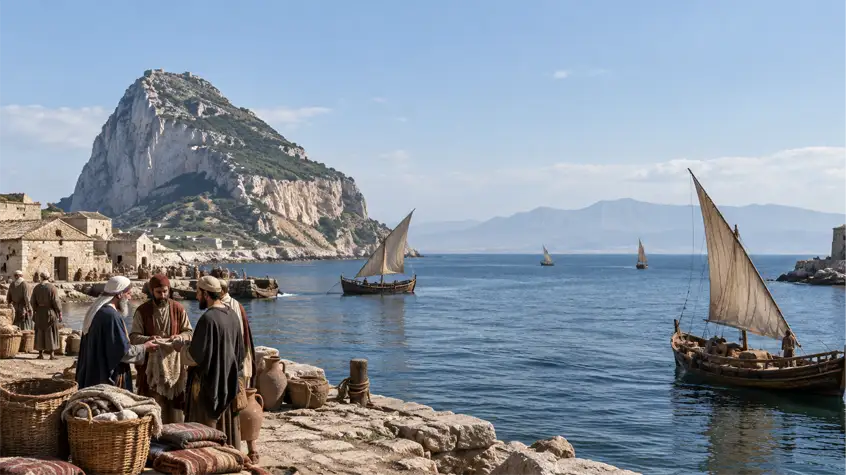
Certified Jewish tour guide
Discover Gibraltar's Jewish Heritage
For those wishing to explore Gibraltar's Jewish history in greater depth, guided heritage tours are available through Gibraltar Jewish Tours & Travel, led by local historian and tour guide Mr Joshua Marrache.
Website: https://gibraltar-jewish-tours.com/
Email: info@gibraltar-jewish-tours.com
Telephone: +350 56001966
Historical material for this page has been developed with reference to information provided by Mr Joshua Marrache, alongside published historical sources.
A History of the Gibraltar Jewish Community
Early Jewish Connections to Gibraltar
Gibraltar's Jewish history is inseparable from its unique geographical position at the meeting point of Europe and Africa. Overlooking the Strait of Gibraltar, the Rock has for centuries been a gateway between the Mediterranean and the Atlantic, bringing together different peoples, cultures and trading communities.
Jewish connections to Gibraltar long predate the establishment of the modern community under British rule. During the medieval period, Jews lived and traded throughout southern Spain and North Africa, maintaining connections across the Strait.
Historical accounts record an episode in the mid-14th century involving members of Gibraltar's Jewish community contributing towards the redemption of Jewish captives taken by pirates. This offers a fascinating glimpse into Jewish communal life long before the British period.
Following the Christian reconquest of Gibraltar in 1462, the territory also became associated with Conversos — Jews who had converted to Christianity, often under pressure. These early chapters form part of Gibraltar's complex religious history and provide the background to the community that would emerge centuries later.
British Rule and the Establishment of the Modern Community
The capture of Gibraltar by Anglo-Dutch forces in 1704, during the War of the Spanish Succession, marked the beginning of a new chapter.
As Gibraltar developed under British administration, Jewish merchants, particularly from Morocco, began establishing themselves in the territory. Their commercial networks and connections across the Strait were valuable to the developing garrison and port.
The Treaty of Utrecht in 1713 formally transferred Gibraltar to Britain. Although Article X contained provisions restricting Jewish and Muslim residence, Jewish settlement continued despite periods of uncertainty and opposition.
The relationship between Gibraltar and Morocco became particularly important. Jewish merchants helped facilitate the supply of goods and provisions, demonstrating how commerce and Gibraltar's strategic needs contributed to the development of a permanent Jewish community.
Over time, Jewish families established homes, businesses and religious institutions, laying the foundations of the community that continues today.
The Establishment of Gibraltar's Synagogues
One of the most significant milestones in Gibraltar's Jewish history was the establishment of the Great Synagogue, Sha'ar Hashamayim, in 1724.
Associated with Rabbi Isaac Nieto of London, the synagogue provided a permanent centre for Jewish worship and communal life. Before its establishment, religious services had been held in private premises.
As the community grew, further synagogues were established, reflecting the different traditions and backgrounds of Gibraltar's Sephardic Jewish population.
Etz Hayim, commonly known as the Little Synagogue, developed from a religious study establishment and became a synagogue in 1759. Its history reflects the particularly strong connections between Gibraltar and Moroccan Jewry.
Nefusot Yehudah, also known as the Flemish Synagogue, was established towards the end of the 18th century. Its distinctive architecture reflects influences from the wider Sephardic world.
The Abudarham Synagogue, established in the early 19th century, further strengthened Gibraltar's religious institutions.
These synagogues have survived periods of war, reconstruction and social change. Together, they remain among the most important physical reminders of Gibraltar's Jewish heritage and continue to serve the community today.
Gibraltar's Jewish Merchants and International Trade
Gibraltar's strategic location created opportunities for Jewish merchants to develop extensive international commercial relationships.
Trade extended beyond neighbouring Morocco to Britain, the Netherlands, Italy, Portugal, the Americas and other parts of the Mediterranean and Atlantic world.
Merchants maintained relationships with communities in Amsterdam, London, Marseille and Livorno, creating networks that connected Gibraltar to the wider Sephardic Jewish diaspora.
The surviving Jewish population registers and communal records from the late 18th and 19th centuries provide valuable evidence of these connections. They reveal families originating in North Africa alongside successive generations born in Gibraltar, illustrating the gradual development of a settled Gibraltarian Jewish identity.
Aaron Cardozo and Admiral Nelson
Among the most prominent Jewish merchants in Gibraltar's history was Aaron Cardozo, whose commercial success and connections with British naval officers made him an influential figure in the territory.
Cardozo was closely associated with Admiral Horatio Nelson and is remembered for supplying the British fleet during a period when Gibraltar was becoming increasingly important to Britain's naval power.
In 1819, Cardozo built an imposing residence overlooking what is now John Mackintosh Square. The building, later known as the Club House Hotel, eventually became Gibraltar's City Hall.
The building remains an important landmark and a lasting reminder of the contribution made by Jewish merchants to Gibraltar's architectural and commercial heritage.
Cardozo's story illustrates how Jewish families became closely involved in Gibraltar's development as both a commercial centre and a strategic British naval base.
Gibraltar and the Revival of Jewish Life in Portugal
One of the most remarkable chapters in Gibraltar's Jewish history is its connection with the revival of organised Jewish life in Portugal.
Following centuries of persecution and the effects of the Portuguese Inquisition, openly practised Judaism had largely disappeared from Portugal.
During the early 19th century, Jewish merchants and families from Gibraltar and Morocco began establishing themselves in Lisbon, helping to rebuild Jewish religious and communal life.
These families brought with them their religious traditions, commercial relationships and connections to the wider Sephardic world.
The relationship between Gibraltar and Lisbon continued through family, religious and business connections for generations, demonstrating the influence of Gibraltar's relatively small Jewish community far beyond the Rock itself.
Jewish Life and Gibraltar's Commercial Development
During the 19th century, Gibraltar's importance as a naval and commercial centre continued to grow.
The development of steam-powered shipping, the opening of the Suez Canal in 1869 and the expansion of maritime trade strengthened Gibraltar's role as a strategic stopping point for vessels travelling between Europe, the Mediterranean and destinations further afield.
Coal supplies, ship provisioning and naval facilities became increasingly important to the local economy.
Jewish merchants and retailers participated in this commercial growth, particularly through businesses established along Main Street.
These shops served Gibraltar's civilian population as well as the sailors, soldiers and merchants who passed through the territory.
Jewish residents also participated in Gibraltar's developing civic institutions and commercial organisations, contributing to the wider social and economic life of the territory.
The First World War and Lieutenant Solomon Benzecry
During the First World War, Gibraltar played an important role as a British naval base, coaling station and support centre for Allied shipping.
The movement of military personnel and vessels through the port brought considerable commercial activity to the territory. Jewish-owned shops and businesses formed part of the local economy serving servicemen and residents alike.
However, the community's contribution was not limited to commerce. Jewish Gibraltarians also served in the armed forces, including those who enlisted overseas.
One of the most notable was Lieutenant Solomon Benzecry, born in Gibraltar in 1893.
Serving with the Royal Fusiliers during the First World War, Benzecry became known for his extraordinary courage during the fighting at Bourlon Wood in November 1917.
During a German attack, Benzecry and his commanding officer, Captain Walter Stone, remained with a small group of soldiers to help cover the withdrawal of their comrades.
Benzecry was wounded but continued fighting and was killed on 30 November 1917.
His bravery earned him recognition as the Hero of Bourlon Wood, and his memory continues to be honoured in Gibraltar.
His story represents the sacrifices made by Jewish Gibraltarians in the service of their country.
The Second World War and the Community's Return
The Second World War brought profound changes to Gibraltar and its Jewish community.
As the territory became a major Allied military base, much of Gibraltar's civilian population was evacuated to destinations including Britain, Madeira and Jamaica.
Jewish families shared in the uncertainty and disruption experienced by the wider Gibraltarian population. Many were separated from their homes, businesses and familiar communal institutions for extended periods.
Following the war, returning families worked to re-establish their lives and restore the community's religious, educational and social activities.
The experience of evacuation became an important part of Gibraltar's collective memory, reinforcing the shared identity of its diverse population.
Jewish Contributions to Modern Gibraltar
Members of Gibraltar's Jewish community continued to play important roles in public and political life during the 20th century.
Among the most prominent was Sir Joshua Hassan, who became Gibraltar's first Chief Minister in 1964 and was a central figure in the territory's political development.
His leadership demonstrated the contribution of Jewish Gibraltarians not only to commercial and religious life, but also to Gibraltar's evolving civic identity.
The Jewish community has continued to participate actively in the wider life of Gibraltar while preserving its distinctive religious traditions, institutions and cultural heritage.
The Gibraltar Jewish Community Today
Today, Gibraltar's Jewish community remains a vibrant and distinctive part of the territory's multicultural society.
Its four historic synagogues, Jewish educational institutions, religious facilities and communal organisations reflect a strong commitment to Jewish learning, worship and tradition.
The community maintains its Sephardic heritage, shaped by centuries of connections with Morocco, Spain, Portugal and the wider Jewish world.
From its early merchants and religious leaders to its contributions in commerce, military service and public life, Gibraltar's Jewish community has played an enduring role in the history and identity of the Rock.
The Gibraltar Jewish Community (GJC), as the community's administrative and representative body, continues to support communal life and help preserve this remarkable heritage for future generations.
Gibraltar Tourist board
Website: visitgibraltar.gi. Address - 13 John Mackintosh Square, Gibraltar. Phone: +350 200 45000 / +350 200 74950. Email: information@tourism.gov.gi.