
Gibraltar Jewish Community — home

Synagogues

Discover our synagogues, with information to help you connect with communal prayer and Jewish life.

Tradition. Connection. Community.

Tefillot times

Daily services

Shacharit
and
Mincha followed by Arvit:
Times vary weekly.

Shabbat services

Shacharit
In all synagogues.
Mincha and Arvit:
Times vary weekly.

Weekly Mincha and Arvit timetable: pending.

Please contact the community to confirm the current times.

Our synagogues

Gibraltar is home to four historic synagogues, each with its own distinctive character, traditions and history. Together, they reflect the rich Sephardic heritage of Gibraltar's Jewish community and remain central to its religious and communal life.

Sha'ar Hashamayim

Esnoga Grande

49 Engineer Lane, Gibraltar GX11 1AA

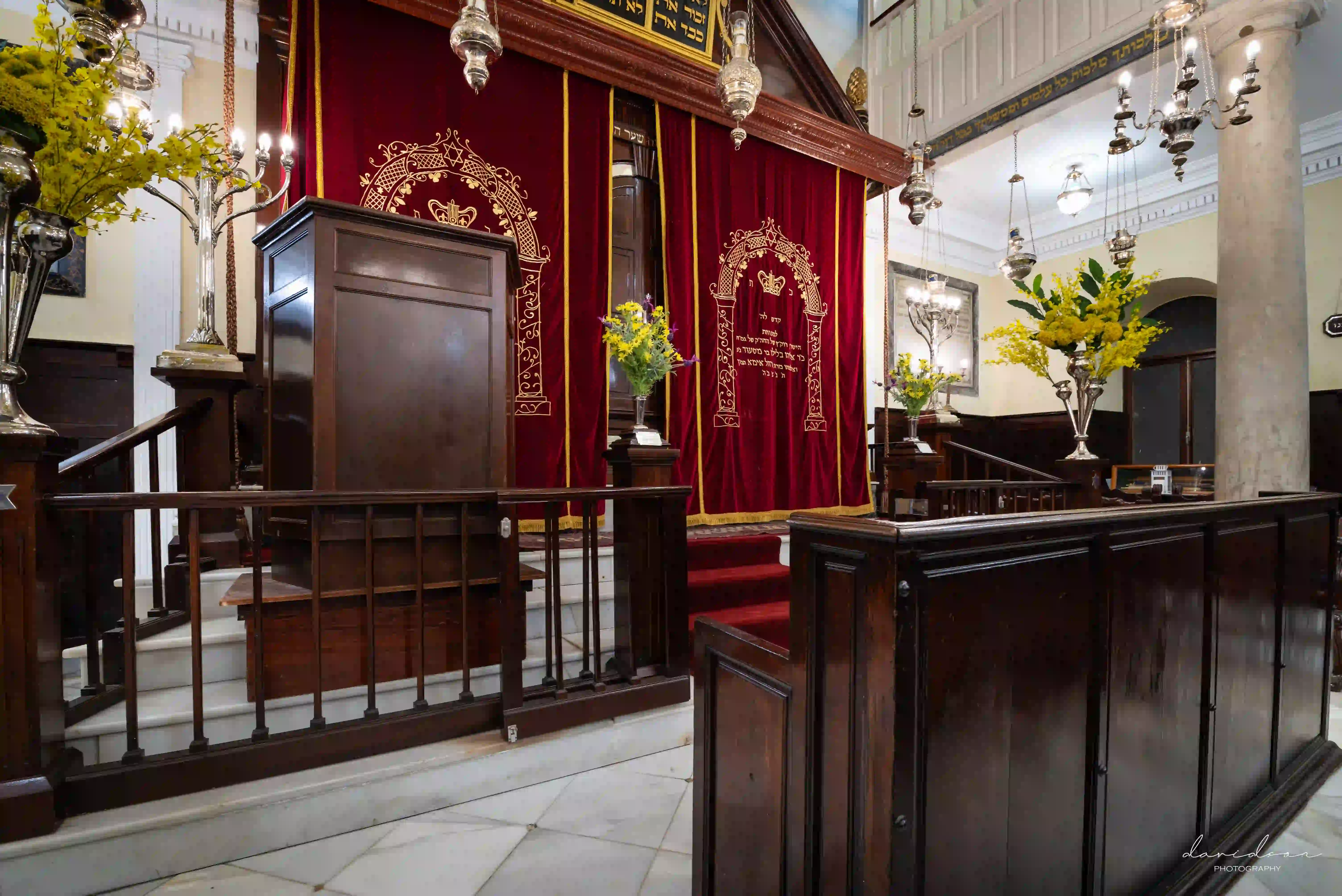
Sha'ar Hashamayim — photograph 1 of 4

This historic synagogue is located in Gibraltar’s center. It is the oldest continuously used synagogue in the British Overseas Territory and the Iberian Peninsula since the Jewish expulsions of 1492

A Congregation Rooted in History

The synagogue's origins trace back to 1724 when Isaac Nieto, a prominent Jewish leader from London, established the Sha'ar HaShamayim congregation.

Nieto played a pivotal role in the early development of Gibraltar's Jewish community. During the 1727 Siege of Gibraltar, he served as the sole importer of food supplies from Morocco, ensuring the survival of the local population.

The land for the synagogue was granted to the Jewish community by Governor Richard Kane in 1724, marking a significant milestone in Gibraltar's history of religious tolerance.

A Story of Resilience and Renewal

The synagogue has undergone several transformations throughout its existence. The original building, accessed via Synagogue Lane (now Serfaty's Passage), was rebuilt in 1768 following a devastating storm in 1766. The second iteration faced destruction during Spanish attacks on 17 May 1781. After the Great Siege of Gibraltar ended, a third structure was constructed. In 1812, a fire damaged this building, prompting an extensive renovation. The current synagogue, completed in the Regency style, retains the vaulted ceilings and elegant features added during the 1812 rebuild.

A Masterpiece of Architecture

Located at 47/49 Engineer Lane, the Great Synagogue is a stunning example of historic design. Its colorful tiles, marble floors, wrought iron spindles, and finely crafted wooden furniture create an atmosphere of reverence and beauty. The synagogue’s facade features round-arched windows and a central doorway that reflect the grandeur of its past while inviting all who visit to appreciate its enduring legacy. It also shares architectural similarities with the Portuguese Synagogue in Amsterdam and the Bevis Marks Synagogue in London.

A Living Heritage

Today, the Great Synagogue remains Gibraltar’s principal synagogue and a cherished landmark. Its historical significance is recognized under Gibraltar’s Heritage and Antiquities Act to ensure its preservation. As a beacon of resilience, faith, and community, the Great Synagogue inspires visitors with its rich history and timeless beauty.

Ets Hayim

Esnoga Chica

89 Irish Town, Gibraltar GX11 1AA

Ets Hayim — photograph 1 of 1

The meat market used to be where the Police Station now stands in Irish Town and its name is preserved in Market Lane and Zoca Flank Battery by the Catholic Community Centre. A number of the Jewish merchants used to meet in the Yeshiva or talmudic academy of Ets Hayim which was situated conveniently close by.

In 1759 it was also turned into a synagogue and its popular name of Esnoga Chica distinguished it from the Great Synagogue.

This building must have been destroyed during the Great Siege and rebuilt subsequently

Nefutsot Yehuda

Esnoga Flamenca

14 Bomb House Lane, Gibraltar GX11 1AA

Nefutsot Yehuda — photograph 1 of 1

In time, Moroccan influence prevailed in the Esnoga Grande and a number of its members decided to build a new synagogue which would revert to the old Dutch customs and order of service. The years from 1793 onwards were ones of great prosperity in Gibraltar as a result of the French Revolution and Napoleonic Wars and the Gibraltar merchants became very wealthy through their ownership of privateers and dealing in the rich enterprises they brought into the Port of Gibraltar. So a grand new building was constructed for a sum of $26,300 (almost £6,000 at the time) on a garden that Shemtov Sequerra, a local Jewish merchant, had bought from John Crusoe. The building was opened for worship in March 1799. The old palm tree in the Courtyard is all that remains of the garden in which the synagogue was built.

The Dutch bell gable can still be seen. The interior was gutted by fire in the early years of the 20th century, and was rebuilt by an Italian architect. This building is therefore, a mixture of styles, Dutch outside and Italian inside, with the reading desk (teva or bima) built into the ark (hehal) instead of being separated as is more usual in Sephardi Synagogues.

From its foundation until 1882, the minister of the synagogue was a member of the Conquy family. Those who have read John Masters’ book, THE ROCK, will remember that the story revolves round the adventures of the Conquy family, who were supposed to have been the original inhabitants of Gibraltar. In fact, the Conquy family came to Gibraltar from Amsterdam in the 18th century.

The family had originated in the city of Cuenca in Spain. The extent to which the congregation of Nefustot Yehuda went to keep to Dutch customs is demonstrated by the fact that in the early years of the synagogue, the ketubot (Jewish marriage contracts) used were sheets taken from a printed book with numbered pages, instead of the hand-illuminated parchments generally used in Gibraltar.

Abudarham

Esnoga Abudaraham

19 Parliament Lane, Gibraltar GX11 1AA

Abudarham — photograph 1 of 1

n 1820, there was another breakaway movement in the Great Synagogue. This time new immigrants from Morocco wanted to have a synagogue which was smaller and less formal than the Gibraltar institutions. This led to the conversion of the Yeshiva of RabbiSolomon Abudarham (who had died in the yellow fever epidemic of 1804) into a synagogue. This building had previously been the Freemasons’ Hall which is why Parliament Lane is still known as ‘Callejon de los Masones’ (the Freemasons’ Street). It is possible that the building had been the seat of the municipal council in Spanish times.